
Why Equipment Spending Is the New Signal to Watch in Semiconductors
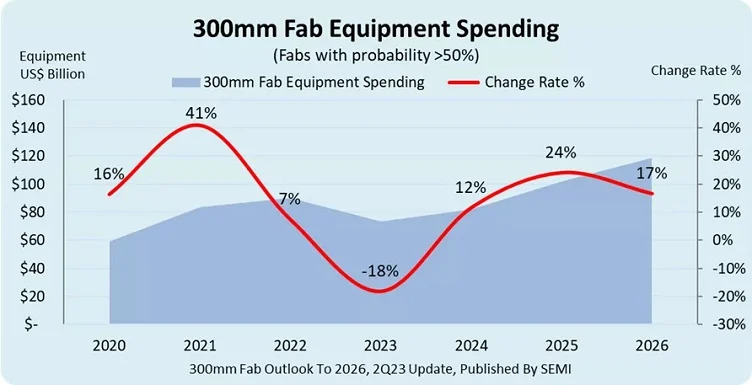 For years, semiconductor buyers have watched lead times, pricing, and inventory levels to understand where the market is headed. Those indicators still matter, but they no longer tell the full story. In today’s semiconductor market, one of the most important signals may be happening further upstream: wafer fab equipment spending.
Recent reporting shows that major memory manufacturers are driving renewed momentum in wafer fab equipment as they prepare for continued demand growth through 2027 and 2028. At the same time, SK Hynix has said it plans to double wafer capacity over the next five years, even as leadership expects the memory shortage to continue into 2030.
Why Equipment Spending Matters
Wafer fab equipment is the machinery used to manufacture semiconductors. It includes lithography systems, deposition tools, etching equipment, inspection systems, and other highly specialized technology required to turn wafers into chips.
When semiconductor manufacturers increase equipment spending, it usually signals that they expect strong future demand. But it does not mean supply will improve immediately.
That distinction is important.
A company can order equipment today, but it may take months or years before that equipment is installed, qualified, and producing usable output. Even then, new capacity must move through testing, yield improvement, packaging, and customer qualification before it becomes reliable supply for the market.
Capacity Announcements Are Not the Same as Available Supply
This is where many market observers get misled. A new fab, equipment order, or capacity expansion can sound like a near term solution. In reality, semiconductor capacity expands slowly.
There are several steps between investment and availability:
• Equipment orders
• Facility buildout
• Tool installation
• Process qualification
• Yield ramp
• Packaging and testing
• Customer approval
Each step takes time. Each step can create delays. That means equipment spending is better understood as a long term signal, not an immediate fix.
For OEMs and manufacturers, this matters because future capacity does not protect today’s production schedule.
Why Buyers Should Watch the Equipment Cycle
Equipment spending can help buyers understand where the industry is placing its long term bets. If investment is concentrated in advanced memory, AI related chips, or specific wafer technologies, that tells buyers which segments are likely to receive priority.
It also reveals which areas may remain constrained.
For example, if capital spending flows heavily toward high bandwidth memory and advanced nodes, older technologies may not see the same level of investment. That can create continued pressure for automotive, industrial, medical, and aerospace applications that rely on mature node components or long lifecycle parts.
In other words, equipment spending does not just show where supply is growing. It can also show where supply may not be growing fast enough.
What This Means for Inventory Planning
The gap between equipment investment and usable supply is where inventory strategy becomes important. When companies know that new capacity may take years to affect availability, they must think differently about how they manage critical components.
This does not necessarily mean overbuying. It means understanding which parts are exposed to long term supply risk and planning accordingly.
For some companies, that may involve earlier procurement. For others, it may involve lifecycle buys, die and wafer banking, or controlled semiconductor storage to preserve components until they are needed.
The key point is that inventory planning must account for time.
Why Semiconductor Storage Fits Into the Bigger Picture
As semiconductor supply chains become more capital intensive, storage becomes part of the infrastructure that helps bridge timing gaps. Components secured today may need to support production months or years later.
That inventory must be stored correctly.
Semiconductors are sensitive to moisture, electrostatic discharge, temperature variation, and handling conditions. Without controlled storage, inventory that was secured to reduce risk can become a quality problem later.
Effective semiconductor storage helps maintain component integrity through controlled humidity, ESD protection, stable environmental conditions, traceability, and proper handling.
The Bigger Lesson
Wafer fab equipment spending is becoming one of the clearest signals of where the semiconductor industry is headed. It shows where suppliers are investing, which technologies are being prioritized, and how long it may take for supply to catch up.
But it also reinforces a practical reality for manufacturers.
Future capacity does not solve present risk.
For OEMs, EMS providers, and long lifecycle industries, understanding the equipment cycle can improve planning. It helps explain why availability may remain tight even when investment is rising. It also shows why inventory strategy, storage discipline, and lifecycle planning are becoming more important in a market where supply takes years to build.