
The Need for Rapid RFQs in the Modern Supply Chain

So much of the business continuity that defines the success of an electronic equipment supply chain — or any supply chain — is based on an OEM’s ability to maintain open lines of communication with their suppliers. The act of transitioning an active electronic component or semiconductor to obsolescence, for example, is a decision made entirely by the component manufacturer in accordance with factors such as raw material availability, manufacturing costs, and buyer demand. Knowing this, it falls to the OEM to actively promote a transparent, mutually beneficial relationship that keeps both parties informed of their intentions.
In practice, however, maintaining such lines can be an exhausting, and costly, endeavor. A single bill of material could contain hundreds of electronic components, and each one may come from a different distributor or component manufacturer. Without committing a full-time inventory procurement team to regularly monitor the market for each and every critical electronic component, the act of ensuring business continuity for the OEM product quickly becomes an exercise in faith.
When the electronic component in question is unavailable through unexpected obsolescence or some related cause, the issue becomes even more pronounced. Should the OEM not properly prioritize these open lines of communication before the buying process is initiated, then there are no lines of communication to rely on once an alternative supplier needs to be quickly found. One at a time, the OEM must contact each individual supplier, ensure their various certifications comply to the OEM’s standards, request a quote, and then compare responses to uncover the best option moving forward.
Even in the best case scenario, the OEM’s scope is limited to the lines of communication they can maintain. If the inventory procurement team sends 10 or 12 requests for quotes, then, at best, it will have only 10 or 12 quotes to compare and use as leverage for better pricing. The electronic component industry is among the fastest growing industries in the world, with the active electronic component industry alone expected to grow approximately 8.4 percent annually between 2015 and 2023; however, if the OEM is only capable of interacting with a limited number of suppliers at any given time, then many of the benefits of a rapidly expanding market (competitive pricing, increased inventory availability) cannot be realized.
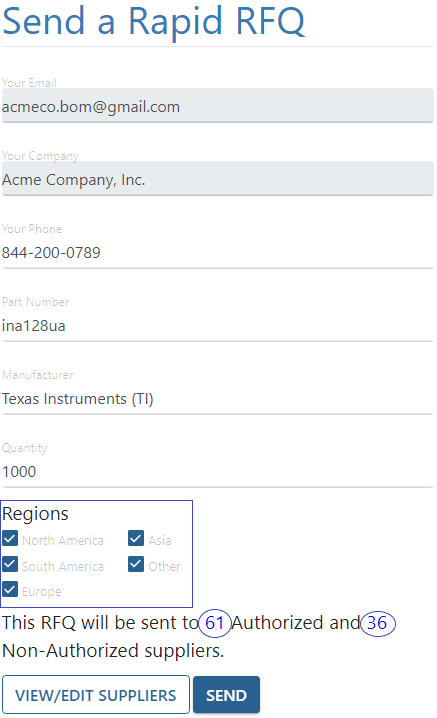
This is why Partstat’s Rapid RFQ system, free to all users with a Partstat account, is such an important tool for today’s supply chain. Where previously OEMs could only maintain relationships with a finite set of suppliers at any given time, OEMs can now instantly request quotes from thousands of authorized distributors simultaneously with a single mouse click. From there, buyers immediately are placed in a position where leverage can be used to negotiate a price far below what could normally be achieved.
Partstat’s online marketplace consists of thousands of manufacturers and authorized channel partners, who each upload their inventory to our platform. This has allowed us to compile a Big Data pool consisting of over 50 billion data points on approximately 23 million unique parts, which forms the backbone of our Rapid RFQ feature. Upon the issuance of the RFQ, all authorized distributors who have quantities of the inventory in question (and are enrolled to receive Rapid RFQs) will immediately be notified of the quote request. Each response will be then be saved directly on the buyer’s dashboard to be easily viewed and shared at any time.
In short, today’s buyers no longer need to be limited by their time and resources; instead, in seconds, they can be instantly connected with a nearly endless number of vetted authorized distributors, limited only by the number of distributors available in the market, all from one central platform that is 100 percent free to use. Time is saved, transparency between buyers and sellers is promoted, and buyers are placed in a position that re-balances the state of the electronic component market in their favor.